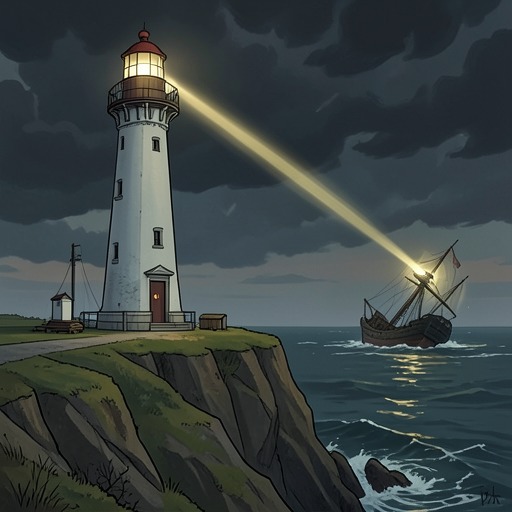
“There were still shipwrecks after the lighthouse was built”
The Lighthouse (Alison Moore Edition)“There were still shipwrecks after the lighthouse was built” is a sentence spoken by Futh’s father during a family picnic on the cliffs in Cornwall, England. First offered as part of his lecture on shipwrecks, it becomes a remembered refrain during Futh’s walk: a compact expression of the novel’s contrast between warnings and the harm that nevertheless follows.
The Sentence on the Cliffs
Futh’s father is holding forth about the lighthouse and eighteenth-century shipwrecks. He describes the plundering of wrecks and the bodies washed ashore and buried without names in unconsecrated land. Against that history, he remarks, “There were still shipwrecks after the lighthouse was built.” The sentence is both a factual observation within his lecture and a pointed contradiction: the presence of a warning did not mean danger had ended.
He continues with practical details about the light flashing every three seconds, its visibility from thirty miles away, and the foghorn used in fog. Futh looks at the lighthouse and wonders how wreckage can persist despite such constant warning and precaution. The phrase’s force lies partly in this mismatch between an apparatus designed to protect and the wreckage left behind.
A Family Scene of Warning and Conflict
The sentence belongs to a scene already charged by friction between Futh’s parents. Futh’s mother lies on the grass while his father speaks at length; she sighs, rolls her eyes, and, when his lecture continues, tells him how much he bores her. Futh has seen this pattern before: his father talks, his mother signals impatience, and his father may lose his temper. The lighthouse story unfolds alongside this familiar domestic tension, making the spoken warning one element in a wider scene of failed attention and strained communication.
Futh wanders away from the picnic with the silver lighthouse perfume case he has taken from Futh’s mother’s handbag. When he returns, the vial is out of its case and the talk of foghorns continues. Futh’s mother says she is going home; as he looks down, he sees blood where the little bottle has broken in his hand, with her perfume in the wound. In this remembered episode, the lighthouse is not only the subject of his father’s lecture but also the form of the object Futh carries, linking the discussion of warning and wreckage to a private injury.
Repetition During the Walk
The sentence returns while Futh is on his circular walk, after he has passed its midpoint and is moving closer to his return to Hellhaus. He abandons the day’s hiking, finds the station, and takes a train to his next overnight stop. As rain begins against the rattling window, the narration shifts into the remembered outing: his father’s line recurs, followed by the details of the flashing light and foghorn. The return places the childhood scene inside the present journey rather than leaving it behind as a completed memory.
The repeated version is shorter in one of its appearances: Futh recalls his father saying, “There were still shipwrecks,” before the memory supplies the rest of the discussion about the lighthouse. That abbreviated echo shows how a phrase can persist even when its setting is compressed. The recollection expands again into the picnic, the parents’ familiar exchange, the stolen perfume, and the broken vial, so the line gathers force through association as well as repetition.
Meaning and Narrative Function
The phrase holds together the father’s account of historical wrecks, Futh’s childhood question about the limits of protection, and the adult journey on which the memory resurfaces. It does not promise that a warning will prevent disaster; instead, it marks the coexistence of warning and harm. The return of the sentence gives that contradiction a verbal shape without resolving it, while the remembered cut supplies a concrete consequence: the small lighthouse-shaped container breaks in Futh’s hand as his mother announces that she is leaving.